

By Joseph Wong
The Malaysian hospitality sector has entered 2026 not just with momentum but with a fundamental shift in its DNA. As the nation celebrates the dual launch of Visit Malaysia 2026 (VM2026) and the Malaysia Year of Medical Tourism 2026 (MYMT 2026), the industry is transitioning from a general leisure destination to a specialised, high-yield global hub.
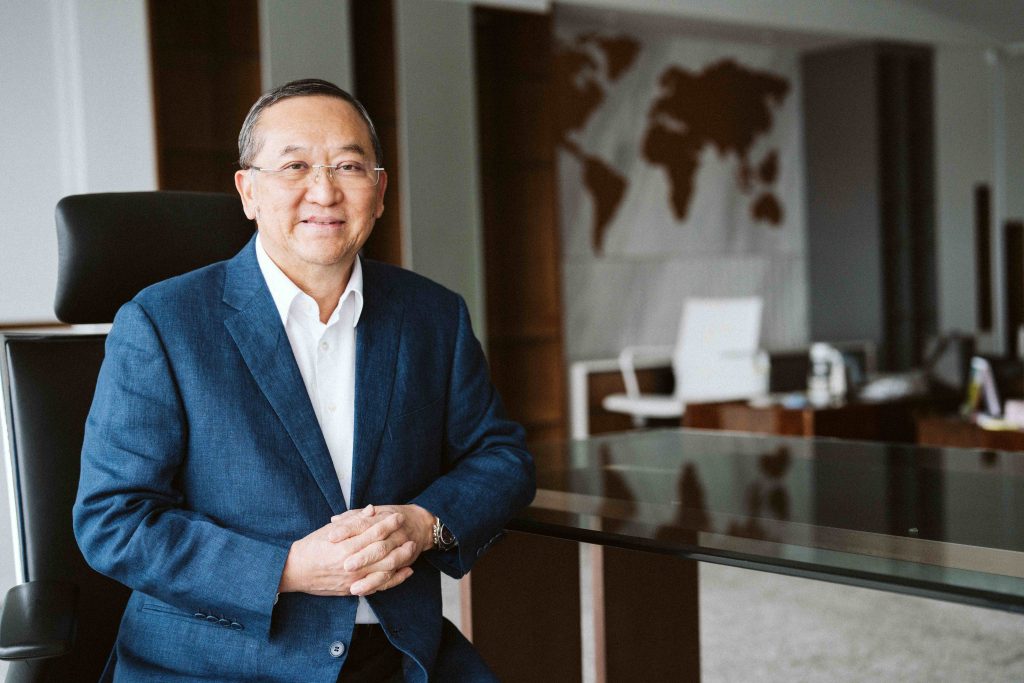
According to Knight Frank Malaysia capital markets (investments) executive director James Buckley, the alignment of government stimulus, infrastructure expansion and a burgeoning medical tourism pipeline is creating an unprecedented investment window.
With international arrivals forecast to reach 29.6 million and tourism receipts projected at a staggering RM329bil, the foundations of the sector are being rebuilt to accommodate a more sophisticated, health-conscious traveller.
“A key growth driver remains China where arrivals rebounded sharply to 3.7 million in 2024 and are projected to reach 7.0 million by 2026 following the extension of visa exemptions. This is expected to lift occupancy and spending across Kuala Lumpur, Penang and Sabah, particularly benefiting midscale and premium hospitality segments,” he said.
The medical tourism catalyst
The focal point of 2026 is undoubtedly health tourism. The Malaysia Healthcare Travel Council (MHTC) has pivoted its strategy toward quality over quantity. While traditional tourism focuses on footfall, medical tourism focuses on length of stay and spend per patient.
The goal is clear. Propel the industry toward RM12.0bil in revenue by 2030. For hoteliers, this means ramping up is about more than just room counts. It is about providing post-operative recovery environments, specialised dietary options and proximity to world-class medical facilities in Kuala Lumpur, Penang and Melaka.
This invasion of health travellers is expected to lift occupancy rates significantly, particularly in the midscale and premium segments where patients and their families often stay for weeks rather than days.
The surge in supply
To meet this incoming demand, the development pipeline has accelerated. Investors are moving away from generic hotels and toward internationally branded luxury assets that offer the reliability and service standards required by premium medical travellers.
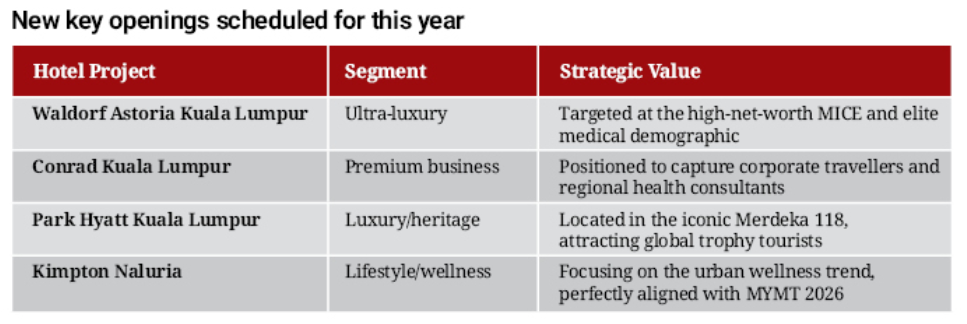
The Klang Valley remains the epicentre of this supply surge, with over 3,200 rooms expected to come online in 2026. This includes a highly anticipated cluster of luxury openings that will redefine the skyline of the Golden Triangle and the TRX District.
Beyond the capital, Penang, Johor, Sabah and Sarawak are seeing measured pipeline growth. These regions are pivoting toward eco-tourism and heritage-led demand, ensuring that the room boom is geographically diversified and resilient to localised market shifts.
Connectivity: The arteries of the industry
Connectivity is the silent partner of the property developer. Buckley highlighted that Kuala Lumpur International Airport’s (KLIA) ranking as the fourth global airport megahub in 2025 has been a game-changer. While long-haul routes are still being rebuilt post-pandemic, the surge in low-cost connectivity has provided a massive boost to mid-scale and economy hotels.
However, the headline of the 2026 infrastructure is the Electric Train Service 3 (ETS3). Launched in mid-December, the direct rail link between Kuala Lumpur and Johor Bahru has finally shrunk the peninsula. “This improved connectivity is expected to enhance domestic travel convenience and boost the tourism sector, particularly in secondary towns such as Segamat, Labis, Kluang and Kulai, in conjunction with the Visit Johor 2026 campaign,” he said.
The Chinese market remains a critical growth driver. This demographic is increasingly moving away from bus tour tourism and toward specialised travel, specifically health screenings and wellness retreats.
This shift is particularly visible in Penang’s resort market which demonstrated extraordinary pricing power in late 2025, achieving 8.6% growth in Average Room Rate (ARR) despite new hotel openings. Similarly, Langkawi has led the resort segment with a 16.4% increase in RevPAR, proving that high-end travellers are willing to pay a premium for exclusivity and security.
Market performance
Hotel performance indicators across Malaysia’s major markets reflect a broad-based recovery:
- Kuala Lumpur (KLCC 5-Star): Occupancy rose to 62% with a 4.8% RevPAR increase, despite the addition of new inventory.
- Johor Bahru: Strong gains in RevPAR of 13.9%, supported by the Singapore factor, where travellers take advantage of the favourable exchange rate and the efficiency of cross-border infrastructure.
- Investment Activity: Hotel transactions reached RM865mil in 2025, surpassing the 10-year average. Private investors are the dominant force here, hunting for value-add opportunities where they can buy underperforming assets and renovate them to meet the 2026 luxury standard.
Challenges: The rebuilding phase
Despite the optimism, Buckley noted that the hospitality sector is still navigating a rebuilding phase for certain routes. Many regional and long-haul networks are not yet at 2019 levels. This creates a temporary advantage for mid-scale and economy hotels which thrive on the current dominance of low-cost carriers.
For upscale and luxury hotels, the challenge in 2026 is ensuring that a broad network connectivity is restored to bring in the high-spending MICE and corporate travellers that sustain premium RevPAR.
With over 3,200 rooms being added and billions in revenue at stake, the focus has shifted to specialisation. Whether it is the luxury suites of the Waldorf Astoria or the secondary-town boutiques along the ETS3 route, the industry is no longer just selling a bed. It is centred on health, heritage and high-speed connectivity.
As Buckley and the Knight Frank team observed, investor confidence is at a ten-year high. For those building the concrete foundations of Malaysia’s future, 2026 is the year the world arrives to see just how immovable and impressive those foundations have become. And this will reverberate across the real estate industry, among many others.
This article was first published in StarBiz 7.
Stay ahead of the crowd and enjoy fresh insights on real estate, property development and lifestyle trends when you subscribe to our newsletter and follow us on social media.