

Malaysia’s construction evolution is a two-speed story
By Joseph Wong
As Malaysia’s property sector navigates the complexities of 2026, the industry stands at a critical juncture. On one hand, the skylines of Kuala Lumpur and the burgeoning data centre hubs of Johor suggest a nation hurtling toward a high-tech future. On the other, the vast majority of mid-market residential developments remain anchored in methodologies that have changed little in decades.
With a property-related lending foundation exceeding RM1.2 trillion, the stakes for innovation have never been higher. Yet, a fundamental question remains: Why is Malaysia not moving as fast as developed nations and what will it take to bridge the technology gap?
The most striking feature of the Malaysian construction landscape in 2026 is its two-speed nature. Innovation is currently a privilege of the elite asset classes, specifically data centres and Grade A commercial offices. In these sectors, Building Information Modelling (BIM) and advanced cooling systems are not just extras but fundamental requirements for entry.
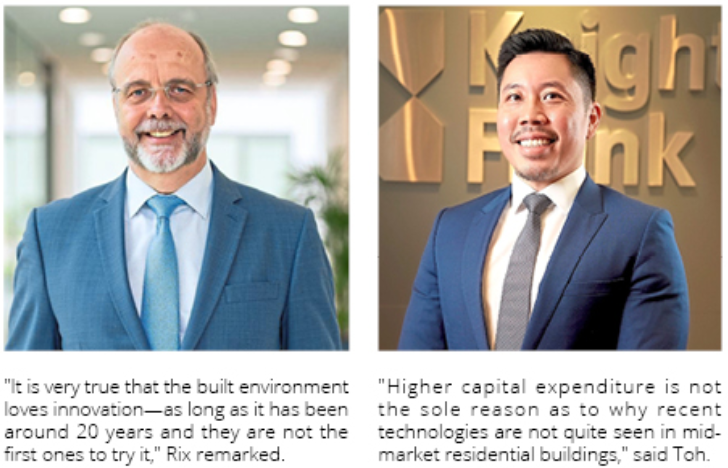
However, the trickle-down effect to the residential sector is notably absent. Knight Frank Malaysia’s project management deputy director Shaun Toh argued that the primary barrier is not merely the high initial Capital Expenditure (CapEx) but a complex calculation of Return on Investment (ROI) and structural suitability.
“Higher capital expenditure is not the sole reason as to why recent technologies are not quite seen in mid-market residential buildings. When assessing technologies, we have to look at return on investment (ROI) and suitability for a particular building.
“Building information modelling provides a high level of information during and post-construction (the maintenance phase). While useful, residential buildings are typically simple in design, with few services and are simple to construct,” he explained.
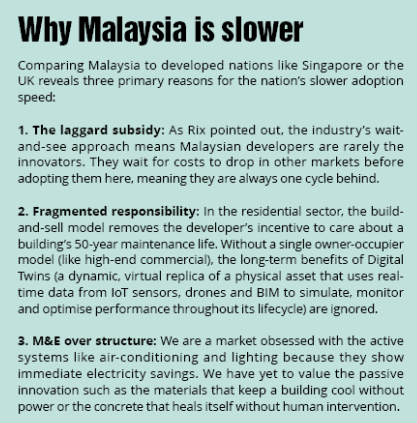
Furthermore, Toh identifies a systemic deterrent, namely, the stratified nature of Malaysian residential property. In a commercial tower, a single owner benefits from long-term maintenance savings. In a stratified residential project, the developer exits after construction and the maintenance falls to a fragmented group of owners. "Developers have little to no interest post-sales and construction," Toh noted, highlighting a fundamental misalignment of incentives.
The cultural barrier
While technical and financial barriers are real, the cultural resistance to innovation within the built environment is equally potent. JLL Malaysia’s data centres project and development services head James Rix provided a blunt assessment of the industry’s psychological hurdle.
"It is very true that the built environment loves innovation—as long as it has been around 20 years and they are not the first ones to try it," Rix remarked. This risk-aversion creates a follower market where developers wait for proven outcomes before committing capital. Rix compared the current reluctance to adopt BIM to the historical shift from paper-and-ink drawings to computer-aided design (CAD). "BIM, by default, should be implemented across all asset classes regardless of cost as the benefits vastly outweigh any perceived negatives," he insisted.
In Rix’s view, the failure to adopt BIM is a missed opportunity for risk mitigation. BIM creates a digital representation of the asset that visualises schedules, assists in costing, and most importantly, resolves design clashes before a single brick is laid. For an industry plagued by cost overruns and re-work, the technology gap is effectively a productivity gap.
Speed over quality?
One area where Malaysia has seen significant movement is the Industrialised Building System (IBS). Promoted heavily by the government, IBS is now a mainstay for many developers but for reasons that may surprise the casual observer.
According to Toh, the adoption of IBS is less about the quality of the final build and more about solving a chronic crisis: the skilled labour shortage. "IBS is quite widely used by Malaysian developers to improve the speed of construction while also addressing skilled labour shortages at the same time," he noted. However, Toh cautioned that there is currently insufficient evidence to suggest that high-degree IBS or 3D-printed buildings result in faster take-up rates or higher resale velocity.
Building Materials Distributors Association of Malaysia (BMDAM) president Lim Chun Heng echoed the importance of IBS but framed it as a path toward broader industrialisation. "IBS involves the prefabrication of building components in a controlled environment before installation on-site, helping to improve construction quality and consistency," Lim said. For Lim, the future of the industry lies in modular systems that reduce construction complexity and minimise material wastage.

The material dilemma: Is there a Green Premium?
As global investors increasingly demand environmental, social and governance (ESG) compliance, the conversation has turned to the Green Premium, that is, the idea that sustainable buildings command higher prices. In Malaysia, however, the data is mixed.
Knight Frank’s Toh confirmed that a Green Premium exists but it is currently tied to energy-efficient mechanical and electrical (M&E) systems rather than the actual skin of the building. "The evidence base for material-specific pricing effects remains limited," Toh observed. Valuation for buildings in Malaysia is still primarily tied to occupancy and rental prices, not the carbon-negative concrete or recycled aggregates used in their construction.
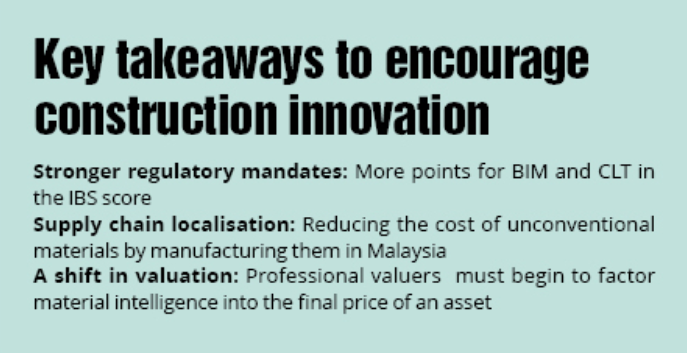
Rix noted that the use of unconventional materials in Southeast Asia is often a matter of logistics rather than pure innovation. "The use of alternative materials often focuses on the ability to obtain these materials locally rather than importing them," Rix said. Importation brings additional costs and maintenance risks, meaning that until Malaysia develops its own supply chain for materials like carbon-negative concrete, they will remain the domain of companies with a high CSR and ESG drive who can justify the CapEx through reduced OpEx.

The regulatory shield
To bridge this gap, the Construction Industry Development Board (CIDB) is focusing on standardisation and technical sandboxes. Mohammad Faizal Abdul Hamid, general manager of CIDB’s Technology Development Division, highlights how CIDB is integrating BIM into the IBS scoring system to ensure that digital innovation translates into physical efficiency.
Since 2018, BIM has been awarded up to six points in the IBS Content Score System. "The application of BIM allows all parties involved in the construction and lifecycle management of the built asset to share and work collaboratively. In the context of IBS or Modular Construction, 3D BIM models are most essential for the planning, designing, fabricating, installing or managing of the IBS components or modular units," Faizal said.
CIDB is also addressing the waste crisis. With 25,600 tonnes of construction waste generated daily in Malaysia, the current 15% recycling rate is unacceptable. CIDB is currently facilitating the development of a Construction Industry Standard (CIS) for Recycled Concrete Aggregate (RCA). By adapting international standards from Japan and China to the local context, CIDB is creating the legal and technical framework that developers need to use unconventional materials safely.
“The adoption of Mass Engineered Timber (MET) in the construction industry is seen as a way to support a circular economy and reduce carbon emissions. Standards on MET such as Glulam, have been developed in the past by the Department of Standards Malaysia (DSM), namely the Malaysian Standards (MS 544) on Code of Practice for Structural Use of Timber and MS 758: Glued Laminated Timber that specifies performance and minimum production requirements for structural glulam members,” Faizal explained.
Furthermore, he pointed out that while standards for MET like Glulam are established, the industry is still waiting for local standards on Cross Laminated Timber (CLT).
"Malaysian Standards for CLT are still being developed to adopt or refer to international standards like Eurocode," he explained. Without these standards, developers cannot gain the fire and safety certifications required to mainstream timber-based high-rises.
The cost of doing nothing
BMDAM’s Lim summarised the situation clearly. He noted that while some innovative materials may involve higher initial costs, they contribute to overall cost optimisation through improved efficiency, reduced labour requirements and shorter construction periods.
For Malaysia to move further, faster, safer, cheaper and cleaner, the nation must move beyond the high-stakes friction between sales and risk. Developers and buyers must stop viewing technology as an optional luxury and start viewing it as a mandatory tool for protecting our real estate foundation.
As Malaysia looks toward 2H 2026, the mandate is clear. The industry must move from preaching about climate change to delivering buildings that provide tangible, measurable benefits to the end-user. Innovation is not just about a cleaner future but about ensuring that the properties that are built today are still valuable, safe and efficient tomorrow.
Stay ahead of the crowd and enjoy fresh insights on real estate, property development and lifestyle trends when you subscribe to our newsletter and follow us on social media.