Decoding Malaysia’s luxury real estate frontier
By Joseph Wong
Once a niche super-luxury property concept restricted to global financial capitals like London, New York and Tokyo, branded residences are now steadily reshaping the skyline of Kuala Lumpur. Over the past decade, the strategic fusion of five-star hospitality brands, high-fashion houses and residential real estate has evolved from an experimental concept into a potential foundational pillar of Malaysia’s luxury property market.
From the high-density Golden Triangle of Kuala Lumpur to the heritage coastline of Penang and the strategic waterfronts of Johor, branded residences are capturing the capital of high-net-worth individuals (HNWIs) and foreign trophy-asset collectors. However, as the market slowly solidifies beyond its initial honeymoon phase, investors and developers alike are scrutinising what drives the segment's price premiums, how brand continuity operates and whether incoming supply risks saturating the ultra-luxury buyer segment.
“The proliferation of high-end hotel brands and branded residences in these states has been driven by demand among the high-net-worth set for lifestyle experience. These individuals and families are willing to pay a premium for the comfort, security, privacy and highly serviced amenities the segment offers plus the prestige of living in a branded residence,” said Knight Frank Malaysia Penang Branch senior executive director Mark Saw.
From niche curiosity to 9,500-unit horizon
The growth trajectory of Malaysia’s branded residence sector highlights a structural shift in developer strategy and buyer preference. According to data and market intelligence from real estate consultancy JLL Malaysia, the sector, encompassing properties for sale managed by reputable international hotel brands or developer-operator entities, has demonstrated sustained expansion.
"The sector demonstrates sustained expansion with nearly 7,000 units completed to date and a robust pipeline of 2,500 additional units scheduled for delivery by 2030," noted JLL Malaysia research and advisory director Geena Poon.
The Klang Valley remains the undisputed epicentre of this growth. The KLCC and city-centre submarkets alone saw approximately 4,200 units delivered between 2011 and 2020. Initially anchored by international luxury marquee brands establishing their maiden Malaysian presence, the ecosystem has progressively broadened to include upscale, mid-scale and fashion-led lifestyle brands.
Simultaneously, domestic hospitality brands held under developer-operator models such as Berjaya Hotel Management and Sleeping Lion under the AXON Group have matured, capturing approximately 10% of total market share.
Regional diversification is accelerating beyond the capital. Penang has emerged as a boutique luxury destination, integrating international hospitality names such as Westin and Marriott into Georgetown’s heritage coastline and Gurney Drive. In the south, Johor Bahru is positioning itself to capitalise on cross-border demand generated by the Johor-Singapore Special Economic Zone (JS-SEZ) and the Johor Bahru–Singapore Rapid Transit System (RTS) Link, exemplified by developments like Skypark Kepler by Bayan.

What drives the 20% to 40% pricing surge?
In Malaysia, branded residences command an average price premium of 20% to 40% over non-branded, premier luxury condominiums in immediate proximity. While developers incur significant upfront costs to bring a global marquee on board, including brand commitment fees ranging from US1mil(RM4.08mil)toUS5mil (RM20.4mil), technical service fees between US200,000(RM816,000)andUS400,000 (RM1.632mil) and ongoing residential marketing license fees of 1% to 6% of gross unit sales, these expenditures are passed directly into the property's pricing structure.
However, as JLL Malaysia pointed out, a brand logo alone cannot sustain a premium if the underlying real estate fundamentals are weak. "Premium pricing reflects two key factors: strategic location and brand strength," explained JLL Hotels and Hospitality Group’s advisory and asset management senior vice president Joshua Tay. "Projects commanding price premiums are typically located in sought-after addresses with unique value propositions such as Kuala Lumpur’s KLCC precinct, Georgetown's heritage waterfront with sea views and Johor Bahru’s coastal developments supporting trophy asset status and sustained asset value."
Prestige seekers vs yield investors
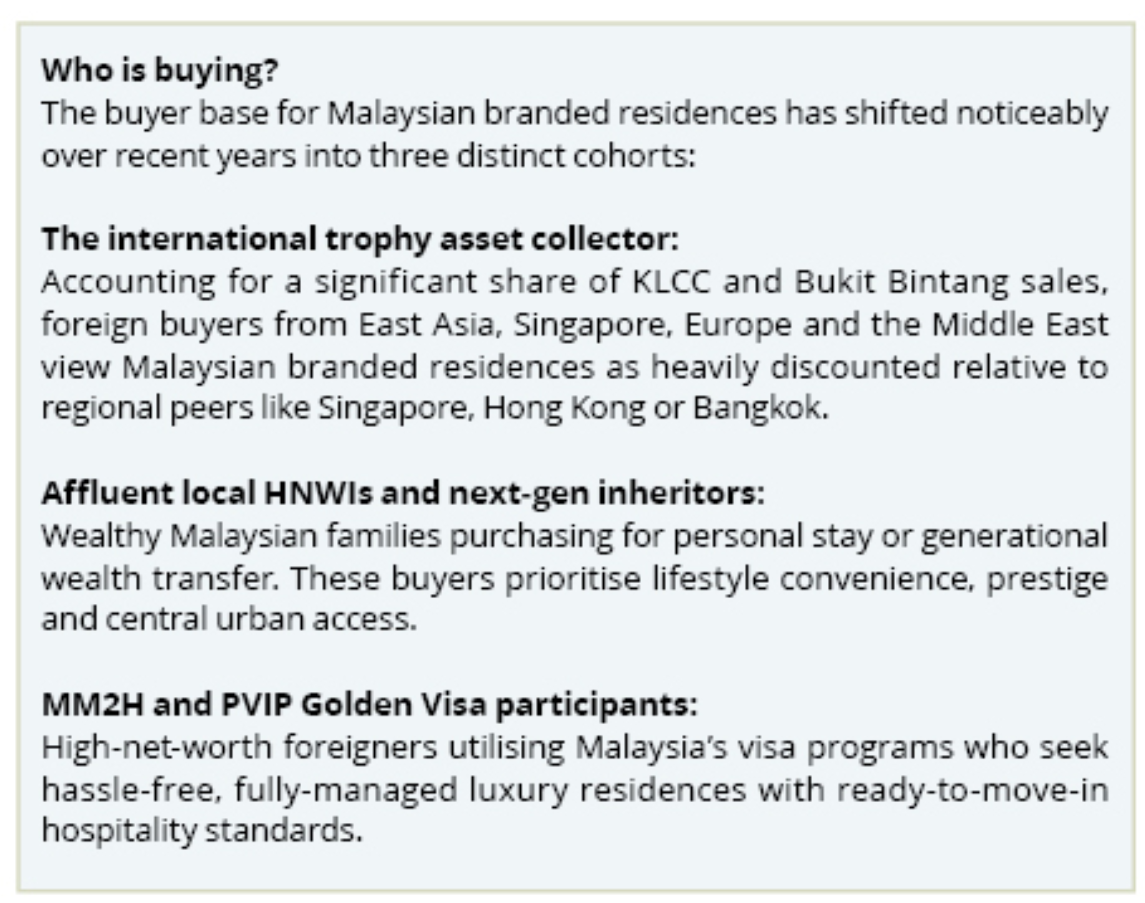
The buyer pool for Malaysian branded residences has split into distinct investor cohorts based on project tier, location and capital intent.
"Buyer motivations differ across branded residence tiers and buyers’ profiles and in reality, these factors are rarely mutually exclusive," said Poon. "Units in KLCC's premium locations managed by luxury brands attract predominantly overseas buyers motivated by trophy asset acquisition and brand prestige.
“Notable examples include Four Seasons Private Residences and The Ritz-Carlton Residences which drew substantial interest from foreign buyers originating from the Middle East, Japan, Mainland China and South Korea."
Conversely, projects located in the broader KLCC–Bukit Bintang fringe managed by upscale, lifestyle or professional property management groups appeal to local investors prioritising rental yield and long-term capital appreciation at accessible entry points.
Landmark developments
Several flagship developments demonstrate how global hospitality brands adapt their operating models to Malaysia's urban fabric. Among them are Four Seasons Private Residences Kuala Lumpur, The Ritz-Carlton Residences Kuala Lumpur, YOO8 at 8 Conlay and SO/ Kuala Lumpur Residences, noted Saw.
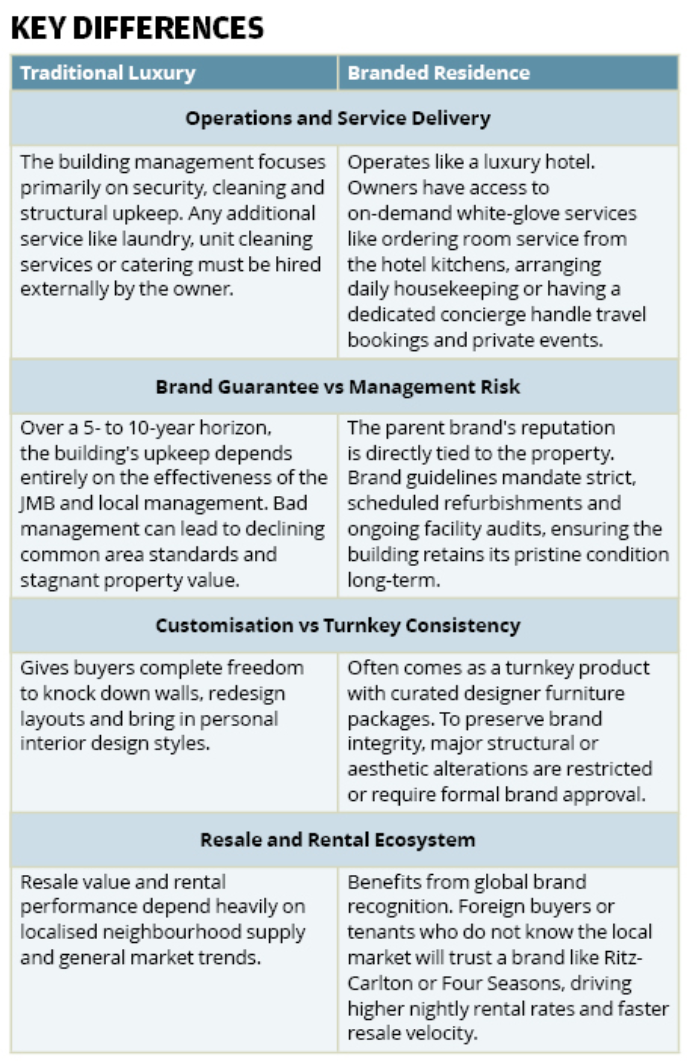
Understanding the differences between branded residences and traditional luxury condominiums requires looking beyond surface aesthetics at operations, legal structures and long-term value preservation, he told StarProperty via email.
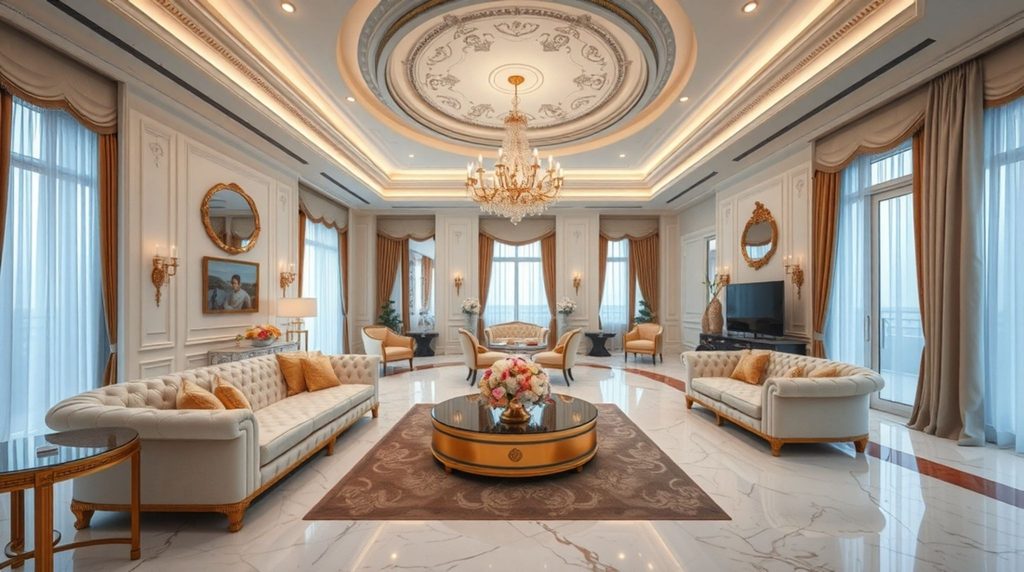
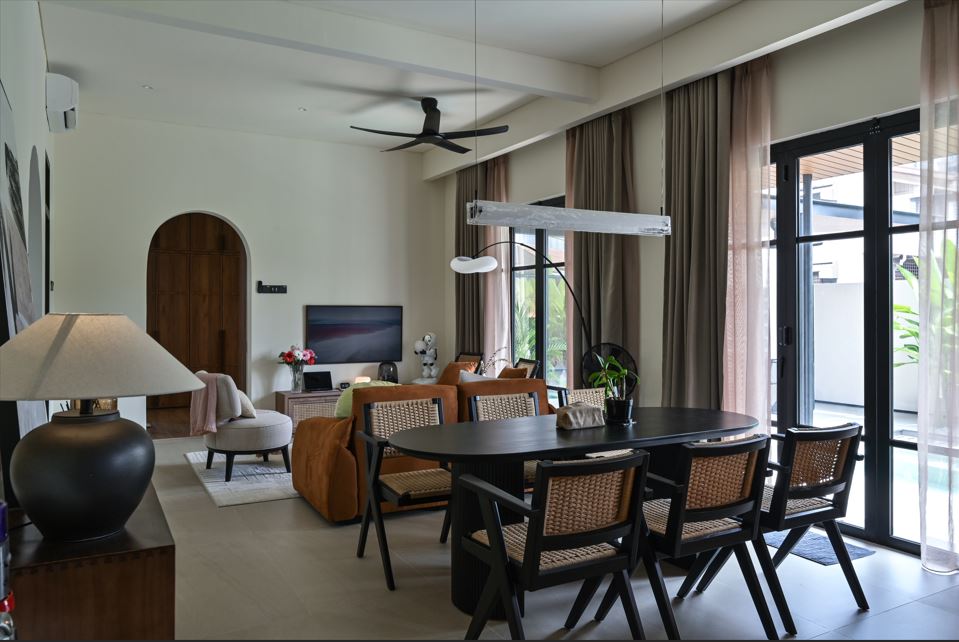
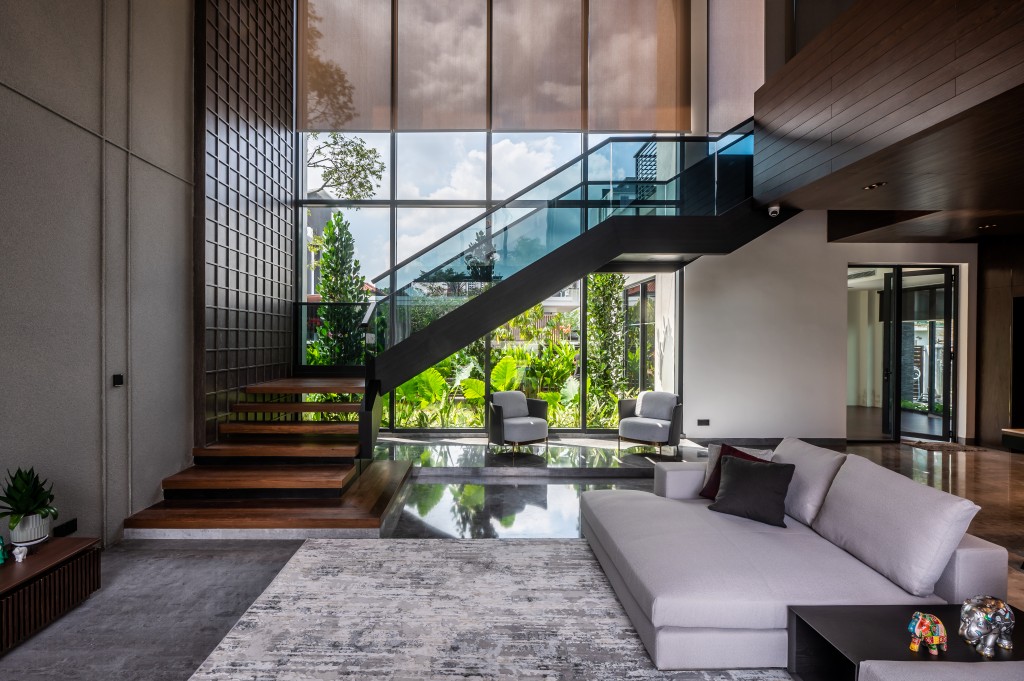
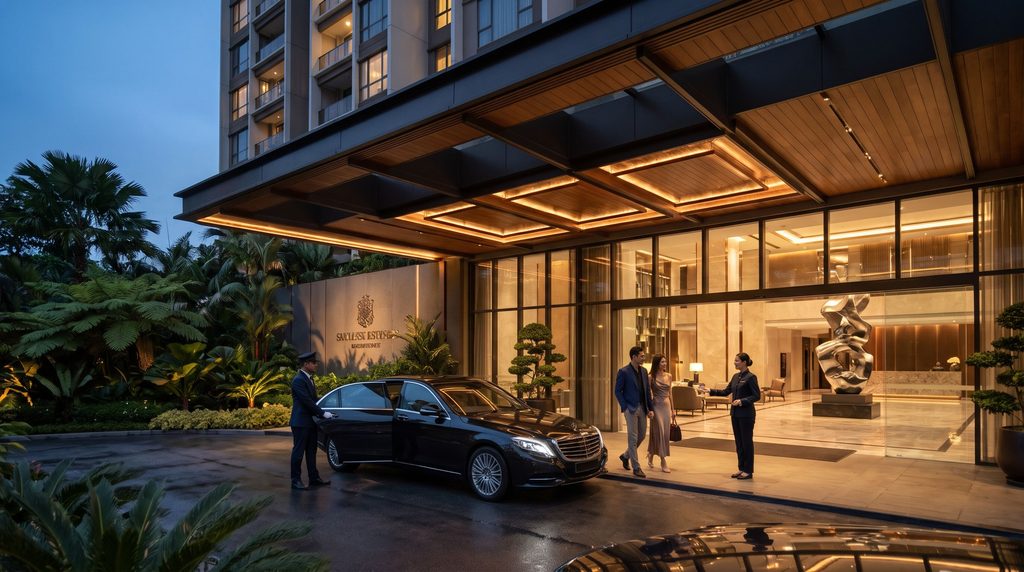
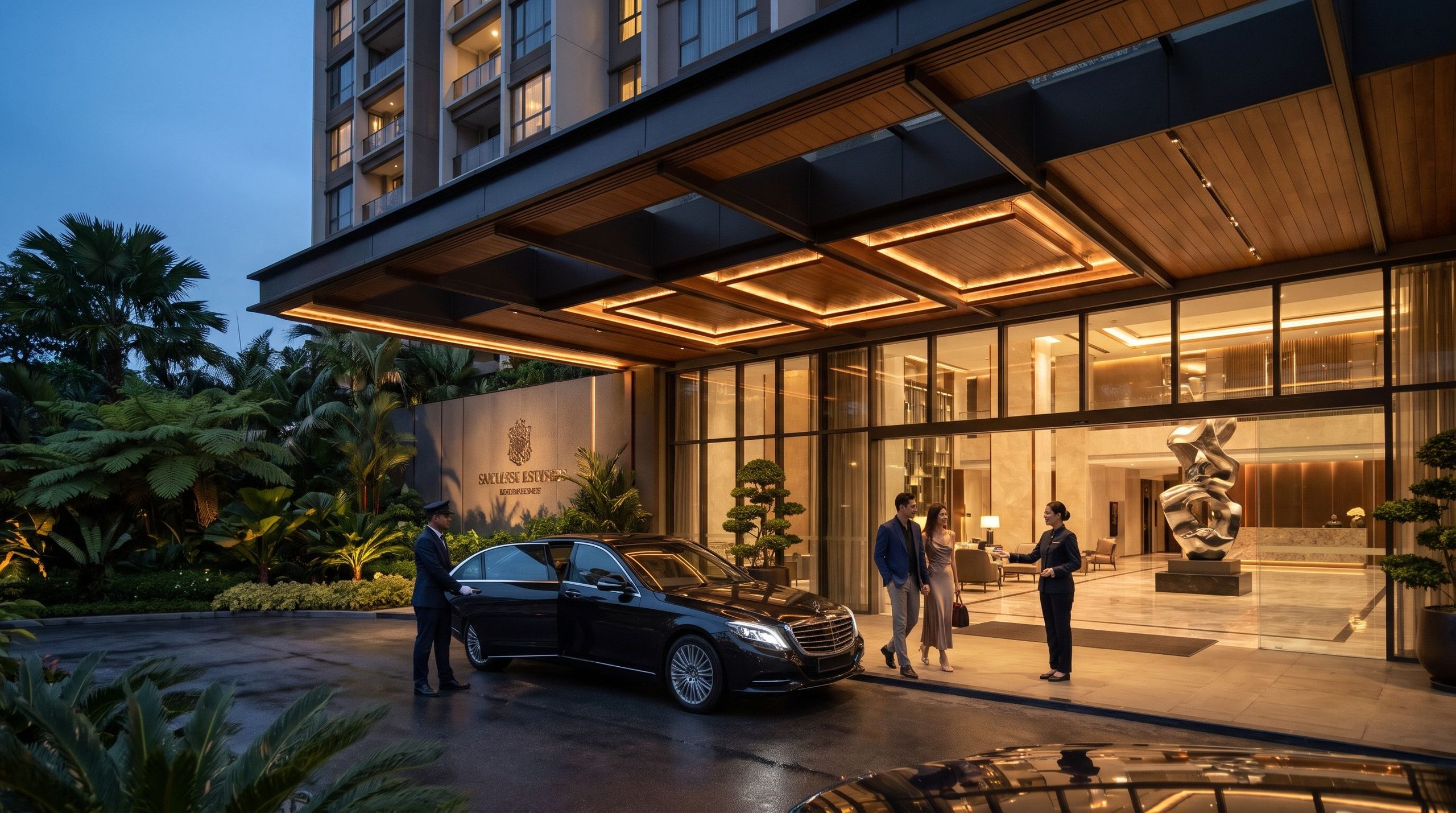
Traditional luxury developments focus on physical security, building cleanliness and structural upkeep. Any additional service must be sourced independently by the owner. Branded residences operate like an extension of a five-star hotel, giving residents access to room service, daily housekeeping, valet parking and private event catering managed directly by the brand's team.
Over a 10-year horizon, a traditional luxury building’s condition depends on the competency of its Joint Management Body (JMB) or Management Corporation (MC). In contrast, parent hospitality brands enforce strict, scheduled refurbishments and ongoing facility audits to safeguard their brand equity, protecting the property from physical degradation.
Many hotel-led branded residences allow owners to opt into an integrated rental program managed by the operator. When the owner is not in residence, the unit enters the hotel's room inventory, generating revenue that helps offset ongoing carrying costs and maintenance charges.
The frontier of Malaysian luxury real estate
The ascension of branded residences in Malaysia reflects the ongoing maturation of the country's luxury real estate ecosystem. By combining global hospitality standards with prime urban addresses, the segment offers an attractive proposition for international trophy collectors, domestic HNWIs and regional investors alike, said Saw.
As the pipeline expands toward 9,500 units by 2030, long-term success will depend on operational execution, brand continuity and precise project positioning. For discerning buyers, branded residences offer more than just high-end real estate; they deliver a turn-key lifestyle identity, managed services and an asset anchored by international brand equity.
What happens if the brand exits?
A critical risk factor that buyers often overlook is the legal structure of the brand partnership. Many owners assume they hold a direct contractual relationship with the managing hotel brand. In reality, the legal dynamics are far more nuanced.
"A key point buyers often overlook is that they have no direct relationship with the brand," revealed JLL Hotels and Hospitality Group’s advisory and asset management senior vice president Joshua Tay. "The licensing agreement is with the developer, not individual owners. As such, any recourse sits with the developer and only to the extent the sale and purchase agreement provides for it."
When evaluating a branded residence, buyers should instruct their legal counsel to conduct due diligence across three core contractual areas:
- Term of the brand license: The exact duration of the branding agreement between developer and operator.
- Termination rights: The specific default conditions that allow the brand to remove its name from the building.
- De-branding covenants: Whether restrictive covenants exist that prevent the developer from unilaterally changing operators.
Furthermore, the MC’s role post-handover is limited. Assignment of the developer's license rights to the MC is uncommon in Malaysia. The MC typically engages the brand as a service provider, meaning it can change operators if required but does not inherit the developer's original contractual relationship with the brand.
Should a brand exit occur, what happens to the property's value? The impact of a brand exit depends on what replaces it and the strength of the property's underlying fundamentals, explained Tay.
"A comparably positioned operator would limit the impact. A move to unbranded management would likely soften the premium, though strong locational attributes can partially offset that compression, as location ultimately remains the most durable value anchor regardless of branding," he said.
As Malaysian developers increasingly leverage global hospitality brands to differentiate their projects in a competitive high-rise market, concerns regarding potential oversupply have emerged. However, JLL’s research indicates that the ultra-luxury segment operates under different dynamics than standard residential stock.
"Branded residences, at least at the upper end and in the regional context, cater to a genuinely niche buyer segment—one that is less price-sensitive and actively seeking a differentiated product," said JLL Malaysia research and advisory director Geena Poon. "This segment provides a degree of insulation from broader high-rise oversupply, as these buyers sit outside the traditional residential market, with the willingness to pay a premium for added services."
Luxury hospitality operators guard their brand equity by remaining selective about location choices and developer partners, which helps keep supply levels measured, said Knight Frank Malaysia Penang Branch senior executive director Mark Saw.
Furthermore, the ability to generate rental income through managed operator programs gives branded residences a practical holding advantage over unbranded luxury units, he added.
According to JLL, the primary risk facing the market is not sheer volume but product-market mismatch. Misalignments such as pairing a luxury brand price point with a secondary location that lacks iconic status or selecting a brand tier that does not resonate with the target demographic create sales velocity risks independent of broader supply figures. When location prominence, brand tier and buyer profiles are properly aligned, the market maintains healthy absorption dynamics.
Stay ahead of the crowd and enjoy fresh insights on real estate, property development and lifestyle trends when you subscribe to our newsletter and follow us on social media.