

By Joseph Wong
The secondary residential property market in Malaysia has opened the year on an exceptionally positive note, with Kuala Lumpur emerging as the primary engine of high-value price appreciation and renewed buyer conviction.
Far from a passive recovery, the sub-sale segment is experiencing a strong resurgence, driven by consumers who prioritise established neighbourhoods, mature infrastructure and immediate connectivity over long construction waiting periods.
According to the newly released Residential Sub-Sale Market Report, based on an extensive dataset of more than 230,000 transactions recorded since 2018 by global real estate agent network IQI, the resale market is outperforming broader property indices.
While the national average sub-sale price climbed a healthy 4.8% year-on-year to RM545,059, it is the performance of the Kuala Lumpur market that has caught the attention of property analysts and developers alike.
The million-ringgit milestone
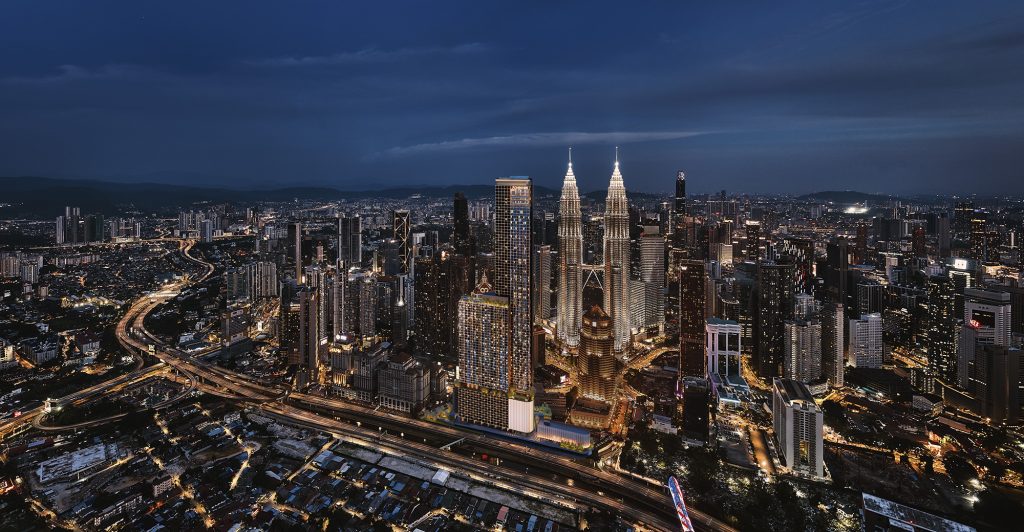
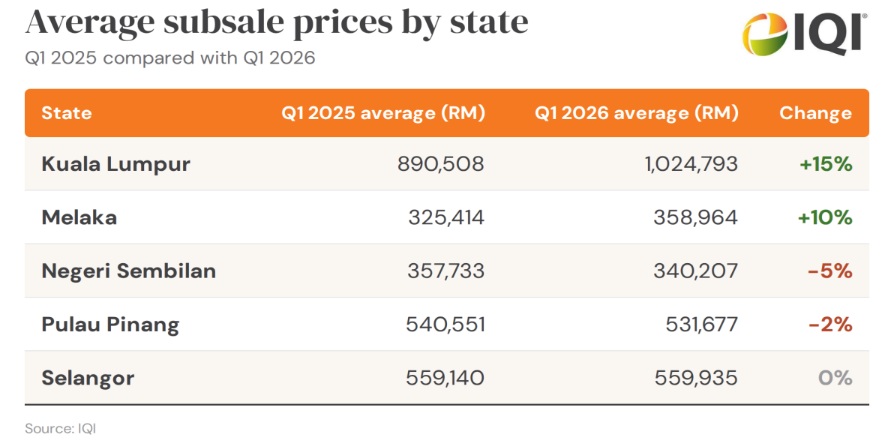
The standout headline of the first quarter is Kuala Lumpur’s decisive breakthrough past a major psychological pricing threshold. The average price for a sub-sale home in the capital city has officially broken through the RM1mil barrier, sitting firmly at RM1,024,793.
This milestone is backed by a remarkable 15% year-on-year surge in average prices, making Kuala Lumpur the fastest-growing urban resale market in the country. In a real estate climate where buyers are highly discerning, this double-digit growth demonstrates a concentrated flight to quality assets in the capital.
IQI co-founder and group chief executive officer Kashif Ansari highlighted that this upward trajectory reflects robust, sustainable buyer confidence in the capital's real estate core. Buyers are showing a willingness to pay a premium for properties situated in established neighbourhoods that offer reliable infrastructure, lifestyle amenities and strong transit connectivity.
The resale premium
The strength of the sub-sale market becomes even clearer when compared to overall residential market indices. IQI’s internal data shows that sub-sale prices are climbing nearly three times as fast as the preliminary all-property House Price Index reported by the National Property Information Centre (Napic) which tracks both new launches and secondary transactions in a combined statistic.
While Napic’s combined index rose by a modest 1.7% over the past year, the sub-sale segment's near-5% national leap reveals where actual transaction heat is concentrated. This performance shows that modern home buyers are actively looking past unbuilt projects, choosing instead to lock down completed secondary assets that offer immediate move-in possibilities and predictable rental yields.
Post-2025 reversal
A retro-perspective analysis over the past nine quarters shows a steady, resilient upward path for the sub-sale market, despite minor quarter-to-quarter fluctuations. Since the first quarter of 2024, national prices have mostly fluctuated within a healthy band between RM500,000 and RM560,000.
Although the market experienced a temporary year-on-year softening of 5.5% in the third quarter of 2025, buyers re-entered the market with strong conviction at the end of the year. This capital influx triggered a sharp upward reversal, ensuring that while the current first-quarter average adjusted slightly lower than an exceptional fourth quarter in 2025, the underlying demand remains significantly stronger than the previous year's baseline.
The regional data highlights a healthy, two-tier market structure. While Kuala Lumpur drives premium capital gains at the top of the pyramid, more affordable entry-level properties provide the steady transaction volume that stabilises the wider property ecosystem.
While Kuala Lumpur stands out as the premium leader, Selangor maintains its role as the stable engine of transaction volume, with average sub-sale prices holding steady at RM559,935. Meanwhile, modest downward adjustments in Pulau Pinang (-2%) and Negeri Sembilan (-5%) point to a broader consumer shift toward accessible price points.
With an average price of RM340,207, Negeri Sembilan has overtaken Melaka as the most accessible sub-sale destination among the five main states. This structural shift provides an excellent alternative corridor for first-time buyers and entry-level investors priced out of the premium Klang Valley core.
Volume mechanics
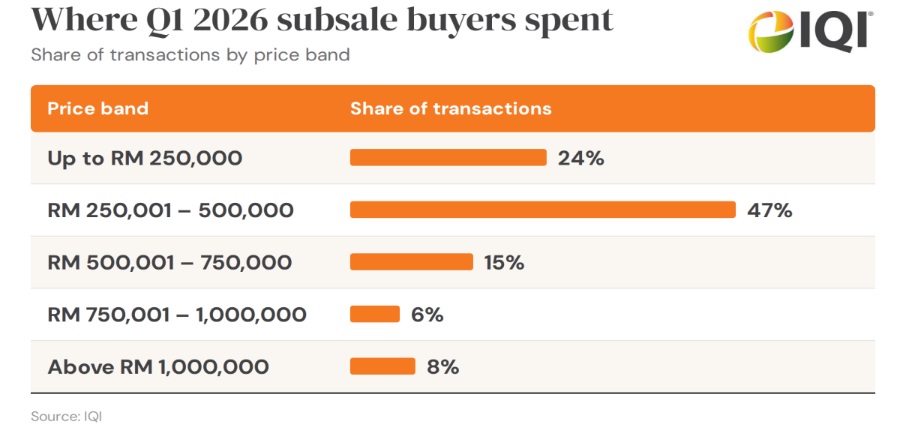
Despite Kuala Lumpur’s million-ringgit breakthrough, the sub-sale market remains highly balanced and accessible to the general public. Properties priced above the RM1,000,000 mark accounted for 8% of total transactions while mid-tier luxury properties between RM750,000 and RM1,000,000 made up just 6% of the volume.
The real backbone of market activity is firmly rooted in the middle-to-lower income brackets. Nearly a quarter of all first-quarter sub-sale transactions were completed for homes priced at RM250,000 or below and approximately seven out of 10 transactions occurred below the RM500,000 mark. This entry-level dominance keeps liquid capital flowing steadily throughout the secondary real estate ecosystem.
The sub-sale property market enters the remainder of the year with steady, predictable and healthy momentum. With over 230,000 historical transactions validating its deep liquidity and active participant base, the resale market has proven its resilience against macroeconomic headwinds.
As entry-level buyers sustain the market's volume base, premier urban centres like Kuala Lumpur will continue to enjoy strong price appreciation. Backed by solid economic growth, ongoing infrastructure expansions and steady organic demand, Malaysia’s secondary property market is well-positioned for a highly successful year ahead.
This article was first published in StarBiz 7.
Stay ahead of the crowd and enjoy fresh insights on real estate, property development and lifestyle trends when you subscribe to our newsletter and follow us on social media.