Contributed by Brig Gen Datuk Goh Seng Toh
The official launch of Malaysia's National Housing Policy (NHP) 2026–2035 has once again generated widespread optimism among aspiring homeowners, property industry players and urban policymakers nationwide. Housing and Local Government Minister Nga Kor Ming has announced an ambitious vision to make housing far more affordable while permanently resolving the issue of delayed and abandoned residential developments.
The flagship centrepiece of this policy announcement is a bold pledge that Malaysia will eliminate abandoned housing projects by 2030. To support this monumental aspiration, the Ministry has unveiled several technological and regulatory initiatives as part of the broader Madani Housing agenda. These include the Housing Integrated Management System, the Transforming and Empowering Data Usage in Housing (Teduh) portal, the Electronic Sale and Purchase Agreement (eSPA) and a series of scheduled audits designed to improve project monitoring and regulatory oversight.
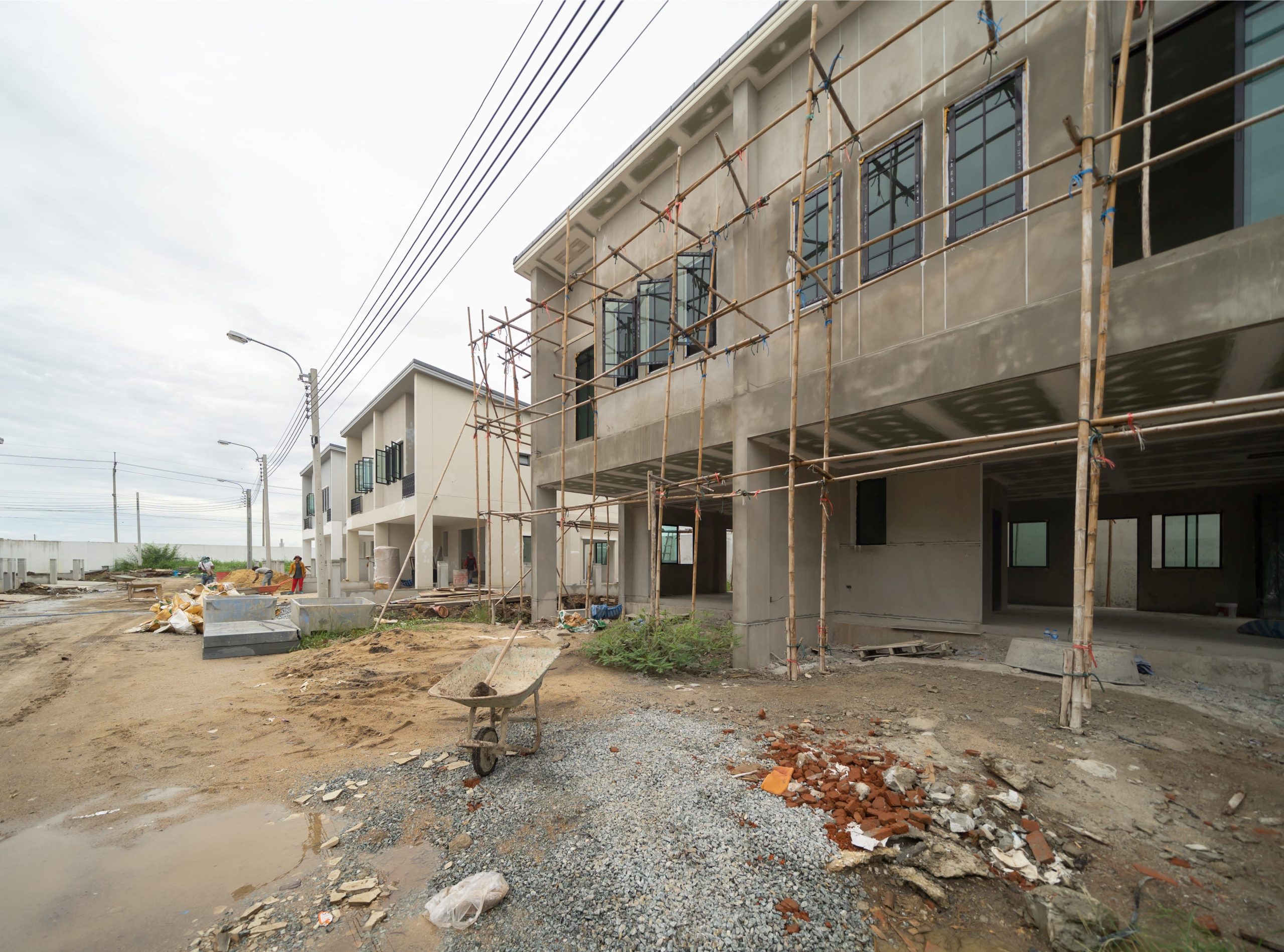
Every Malaysian genuinely hopes the Minister succeeds. Tens of thousands of innocent house buyers have suffered tremendous financial hardship over the past four decades due to abandoned housing developments. Many continue servicing hefty bank loans for homes that remain unfinished concrete skeletons while simultaneously paying monthly rent for alternative family accommodation. For these affected families, homeownership has turned into a prolonged financial nightmare rather than the fulfilment of the Malaysian dream.
The Minister's commitment is therefore both welcome and highly commendable. However, noble intentions alone cannot overcome structural industry weaknesses. The question Malaysians should be asking is not whether the objectives of the National Housing Policy are desirable but whether the government can realistically guarantee zero abandoned housing projects by 2030 without fundamentally changing the housing delivery system.
Walking the talk
Malaysia has never suffered from a shortage of housing policies. Over the decades, successive administrations have introduced comprehensive plans, transformation programs and strategic blueprints promising greater affordability, improved governance and stronger consumer protection. Yet, despite these continuous policy rollouts, abandoned housing projects continue to occur with alarming regularity.
This demonstrates the uncomfortable truth that Malaysia's underlying housing issue is not a shortage of policy papers or vision statements. It is a shortage of actual implementation and structural execution.
Technology is an enabler, not the cure
There is no doubt that the Ministry's newly introduced digital initiatives represent meaningful administrative progress. The Housing Integrated Management System should facilitate better coordination between regulatory bodies, the Teduh portal improves public access to housing data, the eSPA modernises legal documentation and scheduled audits strengthen supervisory oversight. These administrative upgrades deserve recognition and praise.
Nevertheless, technology cannot compensate for inherent weaknesses in public policy frameworks. Digital tracking systems can monitor a failing project but they cannot rescue a property developer suffering from severe capital shortfalls or inadequate corporate financing. They cannot replace prudent corporate management, nor can they eliminate the high risks inherent in a delivery system that relies overwhelmingly on purchasers' progress payments to finance ongoing construction works. Technology must be recognised as an important administrative tool, not the primary cure.
The root cause remains
Malaysia continues to rely predominantly on the traditional Sell-Then-Build (STB) model. Under this system, developers market residential properties long before physical construction is completed. Purchasers sign binding Sale and Purchase Agreements (SPAs) and commercial banks progressively disburse housing loan instalments directly to developers according to technical construction milestones.
In effect, ordinary house buyers finance property construction long before they ever receive the keys to their completed homes. If a developer encounters severe financial difficulties, poor cash flow or management failure, it is the purchaser who bears the brunt of the fallout. Construction slows down, projects become sick and many eventually end up completely abandoned. Meanwhile, buyers are left paying off housing loans for properties that exist only on paper.
This model is neither equitable nor sustainable. No amount of digital monitoring can change this fundamental misallocation of financial risk.
Prevention via BTS
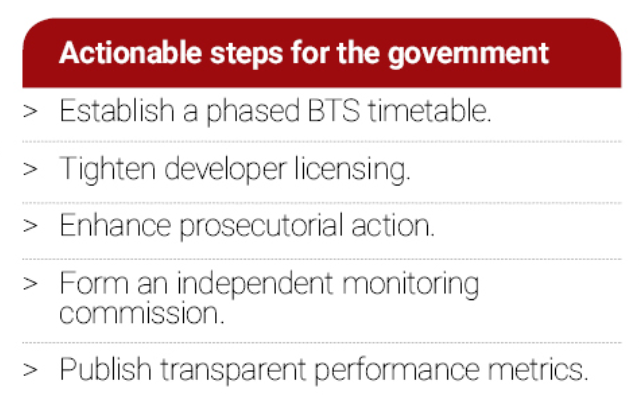
Public policy should always prioritise prevention over intervention. Just as medical professionals prefer preventing disease rather than treating illness after severe complications arise, national housing policy should embrace the exact same philosophy. Government resources ought to focus on preventing project abandonment entirely, rather than attempting to rehabilitate failed projects after house buyers have already suffered financial ruin. The most effective preventive mechanism available remains the Build-Then-Sell (BTS) model.
Under a true BTS framework, developers must demonstrate genuine financial capability by completing construction before collecting full payment from buyers. Purchasers buy completed, physical assets instead of mere promises while development and construction risks remain squarely with those best equipped to manage them: the property developers themselves.
While successive Malaysian governments have acknowledged the inherent advantages of the BTS 10:90 model or the absolute BTS 0:100 model, actual implementation has remained elusive. Continuing to rely on the old STB framework while expecting a totally different outcome by 2030 is simply unrealistic.
Aligning policy with judicial intent
This discussion is not merely about real estate economics. It is fundamentally about legal justice. Malaysia's Apex Courts have repeatedly emphasised that the Housing Development (Control and Licensing) Act 1966 is a crucial piece of social legislation enacted specifically to protect house buyers who represent the weaker contracting party in property transactions.
The Federal Court has consistently ruled that the Act must receive a purposive interpretation to advance Parliament's explicit objective of safeguarding consumers rather than shielding commercial interests. Maintaining a delivery model that transfers immense financial risks onto ordinary buyers runs completely counter to that statutory intent. Every new housing policy must place genuine consumer protection at its very core.
Enforcement and international best practices
The primary challenge in Malaysia has rarely been a lack of legislation but rather inconsistent statutory enforcement. For years, consumer advocates have questioned why criminal prosecutions against errant developers remain infrequent despite explicit penal provisions within the Housing Development Act. Laws that are seldom enforced quickly lose their legal deterrence.
Looking globally, developed nations actively minimise purchaser risk. Singapore enforces stringent licensing rules and financial safeguards on property developers. Australia requires robust project financing and pre-approval standards before developments commence while several European nations require substantially completed properties before full purchase funds are released. Malaysia should actively adopt these proven international standards.
Financially sound, responsible developers have nothing to fear from BTS. While initial capital requirements may be higher, BTS rewards well-managed operators, restores public confidence and elevates the credibility of the entire real estate sector.

Stay ahead of the crowd and enjoy fresh insights on real estate, property development and lifestyle trends when you subscribe to our newsletter and follow us on social media.